

The job interview has clocked out of office hours
One in four interviews starts after 6 p.m., and more candidates interview on Sundays than on Saturdays. That's what Tengai's analysis of more than 20,000 Swedish screening AI interviews shows. An interview outside office hours is no longer the exception. Four in ten candidates choose it.
In the US, the late-night interview is being called the new normal. It even has a name: the 1 a.m. interview. Interview platform Alex AI reports that 48 percent of its interviews take place after hours. According to Wired, recruiting platform Ribbon says one in four automated interviews happens between 10 p.m. and 2 a.m.
Why is hard to pin down, but American candidates have less wiggle room during the day than Europeans. There's no legally mandated paid vacation, employers can let people go for almost no reason, and more people hold more than one job. That leaves the night as the only time to look for something new.
At Tengai, interviews move to evenings and weekends
 Tengai's data shows a similar pattern, with one clear difference. When the interview leaves office hours, it lands in the evening or on the weekend.
Of 20,291 Tengai interviews in Sweden between January 2025 and September 2026, 44 percent started before 8 a.m. or from 5 p.m. on weekdays, or on weekends. One in four started after 6 p.m. 15 percent take place on weekends, and one in three of those start after 6 p.m.
Only 7.4 percent, however, started between 10 p.m. and 2 a.m.
"AI interviews clearly let job seekers fit interviews in when life allows. After work, after daycare pickup, or before the gym. But they don't do it in the middle of the night, which is more common in international data," says Mathias Ahdrian, Head of Sales at Tengai.
Daytime is still the most common, with peaks between 11 a.m. and 3 p.m. on weekdays. Monday and Tuesday are the busiest interview days, while Friday drops to 13.6 percent. One explanation may be that Swedish candidates have more wiggle room during the day. With at least 25 days of paid vacation and legal protection against unfair dismissal, they have more freedom to choose when to do an AI interview.
Employers save time and gain reach
Scheduling is one of recruiting's biggest time sinks. According to GoodTime's Hiring Insights Report 2026, based on responses from just over 500 US talent acquisition leaders, recruiters spend 38 percent of their time scheduling interviews. When the interview isn't tied to a calendar, no booking is needed at all. At Tengai, thousands of interviews took place outside office hours without a single recruiter working late or on weekends.
More candidates also get the chance to take part in the process, since everyone who applies can be invited.
. And the interview data is more comparable, because everyone gets the same questions and is ranked mechanically, whether the interview happens at 11 a.m. or 9 p.m.
"For a recruiter, this is pure relief. Interviews happen when the candidate has time. The recruiter makes decisions on comparable data when they have time. A true win-win," Mathias continues.
Interviewing outside office hours puts candidates in control
Office hours don't work for everyone. According to Statistics Sweden (SCB), 35.5 percent of employed people in Sweden work all or part of their hours outside standard office hours. That's often the case in retail, logistics, and healthcare, industries where Tengai is used today.
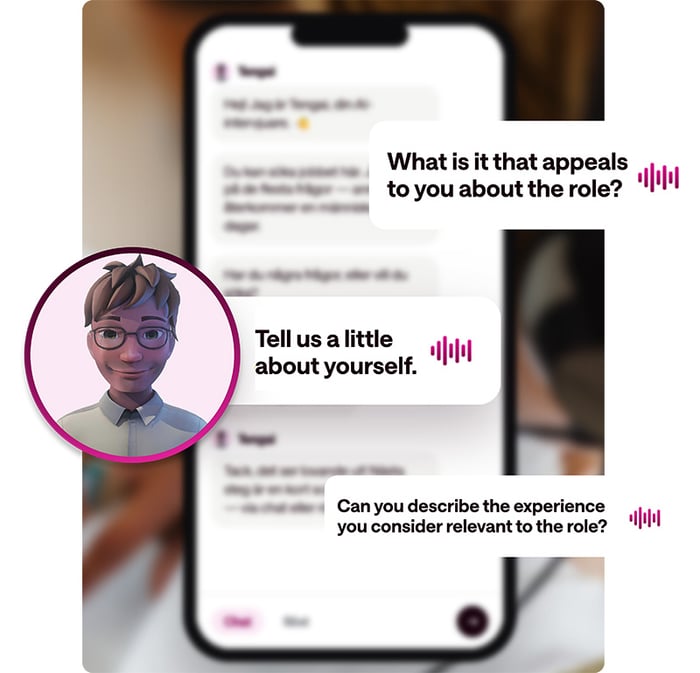
Flexibility isn't enough on its own, though. Transparency matters too, and the EU AI Act requires it. According to Greenhouse's 2026 Candidate AI Interview Report, 70 percent of candidates were never told in advance that AI would assess them, and 51 percent got no feedback. At Tengai, candidates can see that an interactive avatar is asking the questions and reacting on the answers, not just a chat bot.
"Candidates don't want a black box. That's why applicants at Tengai are told right away that AI is involved, and they know a human makes the decisions. Everyone also gets feedback on their screening interview and can reuse the results in other hiring processes," Mathias concludes.
With Tengai, all your candidates take the same structured interview, whatever the time of day. You get a mechanically ranked shortlist to base your decisions on. Want to know more about how it works? Get in touch!
About the dataTengai's analysis covers 20,291 interviews conducted between January 2025 and September 2026. Each interview is counted by the hour it started, in Swedish time. Outside office hours is defined as before 8 a.m. or from 5 p.m. on weekdays, plus Saturdays and Sundays. Key data points
|
Sources
-
Alex AI, 48% of Interviews Happen After Hours: Insights Into Candidate Behavior, alex.com, april 2026
-
Wired, The Rise of the 1 AM Job Interview, wired.com, augusti 2026
-
Moneywise via Yahoo Finance, 24% of AI job interviews now happen between 10 p.m. and 2 a.m. — but many applicants hate robot chats, finance.yahoo.com, augusti 2026
-
GoodTime, 2026 Hiring Insights Report, goodtime.io, 2026
-
GoodTime, Hiring Teams Face Mounting Pressure in 2026, goodtime.io, 2026
-
Greenhouse, 63% of job seekers have faced an AI interview. Most haven't had a good one yet, greenhouse.com, 2026
-
Kollega, ”Aldrig i livet att jag skulle jobba dag” – så är livet på nattskiftet, kollega.se
-
SCB, Arbetskraftsundersökningarna (AKU), scb.se, data från 2018